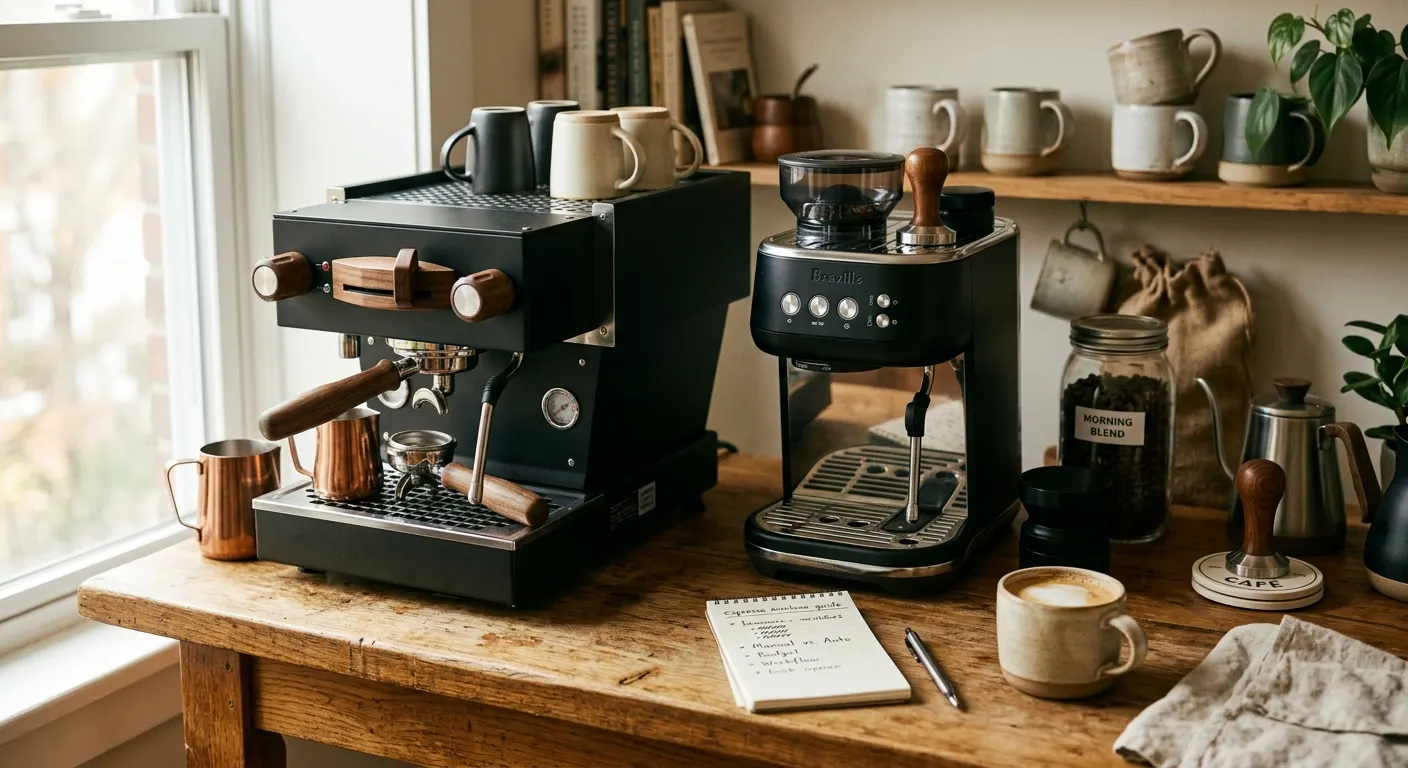
Which Espresso Machine Should You Buy? A Decision Guide
By PullRatio . 12 min read . Updated June 2026
Most espresso machine advice starts with the machines. This guide starts with you. The right machine depends on four questions: how much total budget you have including the grinder, how much counter space you can give up, whether you drink milk drinks or straight espresso, and whether you enjoy tinkering or want an appliance that just works. Answer those honestly and the shortlist collapses from dozens of machines to one or two obvious picks. Below we walk the decision in order, then match the five machines we recommend, from the De'Longhi Dedica Arte to the Rancilio Silvia Pro X , to the person each one actually suits.
Quick answer
For most first-time buyers, the Breville Bambino Plus is the answer: fast heat-up, auto-steam milk, small footprint, around $500 with a grinder budgeted separately. Tinkerers should buy the Gaggia Classic Pro, all-in-one shoppers the Barista Express, tight budgets the De'Longhi Dedica Arte, and committed daily drinkers stepping up should go straight to the Rancilio Silvia Pro X.
This guide contains affiliate links. PullRatio may earn a commission at no cost to you.
Question 1: what is your real budget, grinder included?
The single biggest mistake in machine shopping is spending the whole budget on the machine. The grinder sets your quality ceiling, and a $700 machine fed by a blade grinder loses to a $300 machine fed by a Baratza Encore ESP . Plan your split before falling in love with a machine: under $400 total means a compact machine plus a hand grinder, $600 to $900 means a serious machine plus the Encore ESP or a DF64 Gen 2 Single Dose Grinder , and beyond $1,200 you can pair a prosumer machine with a single-dose grinder without compromise.
If the budget genuinely cannot stretch to a separate grinder, that answers the machine question for you: the Breville Barista Express builds a usable conical burr grinder into the machine and gets you pulling real shots for one purchase. You trade upgrade flexibility for simplicity, and for plenty of people that is the right trade.
Question 2: how much space can you actually give up?
Espresso setups sprawl. The machine is only the start; the grinder, scale, knock box, and tamping area claim their own territory, and the full station easily wants 60 cm of counter. If your kitchen cannot spare that, the De'Longhi Dedica Arte exists for exactly this case: a 15 cm wide body that slips between appliances and still pulls genuine espresso from its pressurized baskets.
The Breville Bambino Plus is the next size up and the better machine: a normal but compact footprint, a 54 mm portafilter, and a thermojet that heats in seconds so it never needs to live switched on. The machines beyond it, the Gaggia and especially the dual-boiler Rancilio, assume a permanent station they never leave.
Question 3: milk drinks or straight espresso?
If your order is a latte, cappuccino, or flat white, steam performance matters as much as the shot. The Breville Bambino Plus is the standout for milk-drink beginners because its auto-steam wand textures milk to a chosen temperature on its own, and it still allows manual steaming when you want to learn the skill. No other machine at the price removes the milk learning curve this completely.
Straight espresso drinkers can ignore steam specs and put every dollar into shot quality and the grinder. That tilts the choice toward the Gaggia Classic Pro , whose 58 mm commercial group and precision-basket compatibility reward technique, or toward the Rancilio Silvia Pro X if the budget reaches it. Heavy milk-drink households pulling several lattes back to back should also look at the Silvia Pro X, because its dual boiler steams and brews simultaneously with no waiting between drinks.
Question 4: do you want a hobby or an appliance?
Be honest about this one. Some people want to taste, adjust, mod, and read forums; others want good coffee with zero ceremony. The Gaggia Classic Pro is the hobby machine: a decade-deep mod ecosystem of PID kits, OPV adjustments, and precision baskets, a 58 mm group that takes commercial accessories, and a manual steam wand that teaches real technique. Our full Gaggia mods guide shows how far it stretches.
If that paragraph sounded like a chore, buy the Breville Bambino Plus or the Breville Barista Express and never think about it again. They are designed as appliances: consistent out of the box, nothing to mod, nothing to tune beyond the grind. There is no wrong answer here, only a wrong match between machine and temperament.
The five recommendations, matched to the buyer
The Breville Bambino Plus (about $500) is the default first machine: fast, compact, forgiving, with auto-steam milk. It is the answer when no other constraint dominates. The De'Longhi Dedica Arte (about $180) is the pick when budget or space is the binding constraint, accepting pressurized baskets as the trade for the price and footprint.
The Breville Barista Express (about $650) wins when you want exactly one box on the counter and one purchase decision, since the built-in grinder makes it espresso-complete out of the gate. The Gaggia Classic Pro (about $450 plus grinder) is for the tinkerer who wants the 58 mm platform and the upgrade runway.
The Rancilio Silvia Pro X (about $1,200 plus grinder) is the buy-once option for the committed daily drinker: dual boilers, PID temperature control, and shot-to-shot consistency that single-boiler machines only approach with practice. If you already know espresso is a permanent fixture in your life, skipping the middle tier and buying it once is the cheaper path; our upgrade path guide makes that case in full.
Whatever you pick, budget for these on day one
Every machine above needs the same supporting cast. A 0.1 g scale like the Timemore Black Mirror Nano Scale is non-negotiable for dialing in. A Normcore WDT Tool and a correctly sized Normcore Calibrated Tamper V4 remove the two biggest prep variables; remember Breville machines take 53.3 mm tampers while the Gaggia and Rancilio take 58 mm.
And the grinder, again, because it cannot be said enough: unless you chose the Barista Express, the grinder is not an accessory, it is half the purchase. Decide on the machine and grinder together, as one budget, and you will skip the most common and most expensive regret in home espresso.
Featured in this guide
Keep reading
Related comparisons
Related roundups
FAQ
Frequently asked questions
What is the best espresso machine for a complete beginner?+
The Breville Bambino Plus for most beginners: it heats in seconds, auto-steams milk so lattes work on day one, and its small footprint fits most kitchens. Budget separately for a grinder like the Baratza Encore ESP. If you want a single all-in-one purchase, the Breville Barista Express builds the grinder in; if money is tight, the De'Longhi Dedica Arte is the honest budget pick.
Is an expensive espresso machine worth it for a beginner?+
Usually not as a first purchase, with one exception. Skill and grind quality matter more than machine price early on, so most beginners are better served by a Bambino Plus or Gaggia Classic Pro plus a good grinder. The exception is the committed daily drinker who already knows espresso is permanent: buying a dual-boiler Rancilio Silvia Pro X once is cheaper than climbing the upgrade ladder through two intermediate machines.
Should I spend more on the espresso machine or the grinder?+
When in doubt, the grinder. It controls grind consistency, which sets how evenly the shot extracts, and a strong grinder with a modest machine beats the reverse. A practical split for a first setup is roughly 60/40 machine to grinder, so a $500 machine deserves a grinder in the $200 to $300 range like the Baratza Encore ESP or DF64 Gen 2.
Which espresso machines need a separate grinder?+
Every machine we recommend except the Breville Barista Express, which has a conical burr grinder built in. The Bambino Plus, Dedica Arte, Gaggia Classic Pro, and Rancilio Silvia Pro X all need a standalone grinder capable of espresso-fine adjustment. Pre-ground coffee is not a workaround, since it goes stale within minutes of grinding and cannot be dialed in.