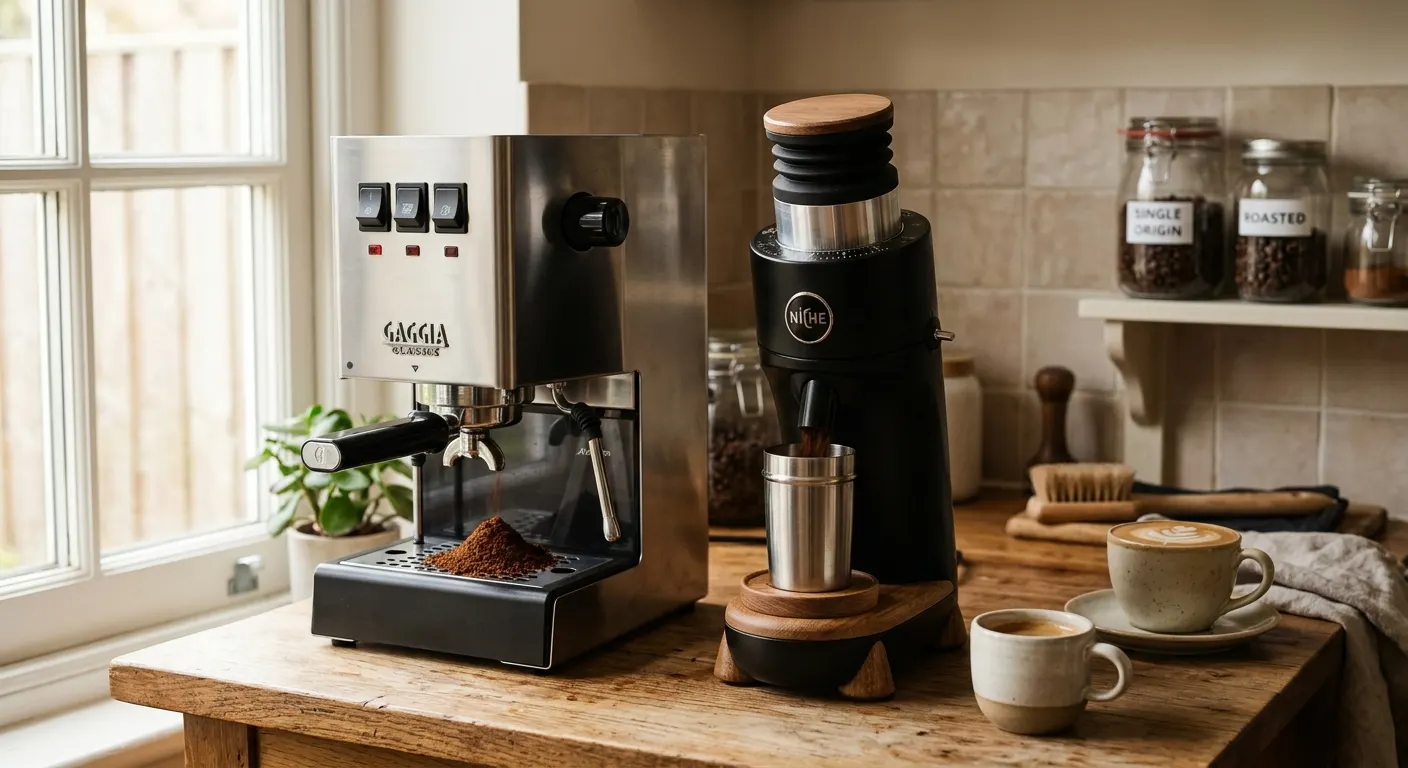
Best Grinder for the Gaggia Classic Pro
By PullRatio . 11 min read . Updated June 2026
The Gaggia Classic Pro is one of the most capable espresso machines under $500. Its 58 mm commercial group head, all-metal construction, and commercial steam wand can produce competition-quality espresso when paired with the right grinder. The grinder, not the machine, is usually what limits results on a Classic Pro. The stock pressurized basket further masks grind quality by compensating for coarse or uneven grinds; when you swap in an IMS precision basket, the relationship between grind quality and shot quality becomes immediate and obvious. This guide covers the grinders worth pairing with the Classic Pro at each budget level.
Quick answer
The grinder is the biggest variable on a Classic Pro once you swap in a precision basket. For most owners the DF64 Gen 2 is the flat-burr value pick, while the Niche Zero wins on near-zero retention and out-of-box consistency. On a tight budget, the Timemore C3 Pro hand grinder works for one or two shots a day.
This guide contains affiliate links. PullRatio may earn a commission at no cost to you.
What the Gaggia Classic Pro demands from a grinder
A single-boiler machine with a solenoid and a commercial group head can extract espresso at a professional level when the puck is correct. The Classic Pro specifically rewards grinders that produce a consistent particle size distribution, because the 9 bar extraction pressure will find and amplify every inconsistency in an uneven grind.
After swapping the stock pressurized basket for an IMS Precision Basket 58 mm or VST Ridgeless Precision Basket 58 mm, you are effectively pulling shots at the same precision level as a specialty cafe. At that point, the grinder is the single biggest variable in your results.
The other dimension is workflow. The Classic Pro requires manual tamping, so grinder retention matters: a high-retention grinder wastes coffee and makes single-dose workflow cumbersome. Low-retention grinders like the Niche Zero and DF64 Gen 2 Single Dose Grinder fit the Classic Pro workflow well.
Flat-burr pick: DF64 Gen 2 ($360 to $430)
The DF64 Gen 2 Single Dose Grinder is the grinder the home espresso community recommends before the Niche Zero for Classic Pro owners who want flat burr performance without the Niche price. 64 mm flat burrs, stepless adjustment, single-dose workflow with low retention, and an upgradeable burr carrier that accepts SSP burrs if you want to go further.
Flat burr grinders produce a more bimodal particle distribution than conical burrs, which some baristas find works particularly well with the Classic Pro group head. The DF64 Gen 2 step-up from Gen 1 includes better retention management and a fork accessory that reduces static during single-dose grinding.
One honest note: the stock DF64 burrs are good but not reference-grade. Upgrading to SSP burrs later is a real option, but it adds $150 to $200 to the total investment, which starts to approach the Niche Zero price. Factor that into your decision.
Step-up pick: Niche Zero ($560 to $630)
The Niche Zero is the grinder Classic Pro owners buy and stop thinking about. Near-zero grind retention means you lose almost no coffee between doses, the stepless adjustment ring allows micro-dialing without jumping between coarse steps, and the conical burr geometry produces a particle distribution that the Classic Pro extracts beautifully.
The Niche is not strictly better than the DF64 Gen 2 in a measurable sense; both produce excellent espresso. The Niche wins on workflow: the retention is lower, the grind consistency is higher out of the box without upgrading burrs, and the build quality matches a machine you plan to keep for a decade.
If your Classic Pro has an upgraded basket and you are using a Normcore WDT Tool and Normcore Calibrated Tamper V4, the Niche Zero makes the grinder genuinely no longer the limiting variable. That is where it earns the price.
Hand grinder option: Timemore C3 Pro ($75 to $90)
If budget is the primary constraint, the Timemore C3 Pro Hand Grinder is capable of espresso-fine grinds that work well in the Classic Pro. The S2C stainless burr set produces a consistent enough particle distribution to make a real espresso, not just a pressurized approximation.
The honest trade-off is workflow time: grinding a 18 g double shot by hand takes 90 seconds or more. For one shot per day, that is manageable. For a household that pulls four shots on a weekend morning, a hand grinder creates friction. Use the C3 Pro as a starter grinder, upgrade to the DF64 Gen 2 or Niche Zero when the hand grinding becomes the reason you skip the espresso ritual.
The puck prep stack that makes any grinder perform better
A better grinder paired with poor puck prep produces worse results than a modest grinder with excellent distribution. After setting up your grinder, add these three steps before tamping.
First, use a Normcore WDT Tool to break up clumps from the grind and create an even bed. Stir in a circular motion until the surface is uniform. A Normcore Dosing Funnel clips to the portafilter and keeps grounds from escaping during the stir.
Second, tamp with a Normcore Calibrated Tamper V4 in the 58.35 mm size for the Classic Pro. The spring-loaded click removes pressure variability. Level tamp, no twist.
Third, add a Normcore Puck Screen 58.5 mm on top before locking in. The screen promotes even water distribution from the shower screen and keeps the shower screen cleaner. With these three steps in place, a Classic Pro with a DF64 Gen 2 can produce shots that compete with machines at three times the price.
Featured in this guide
Keep reading
Related comparisons
Related roundups
FAQ
Frequently asked questions
Is the grinder really the biggest upgrade for a Gaggia Classic Pro?+
Yes. Once you swap the stock pressurized basket for a precision basket, the grinder becomes the single biggest variable in your results. The Classic Pro can pull cafe-level shots, but its 9 bar pressure will find and amplify every inconsistency in an uneven grind. Spend on the grinder before any other upgrade to this machine.
DF64 Gen 2 or Niche Zero for the Gaggia Classic Pro?+
Both make excellent espresso. The DF64 Gen 2 gives you 64 mm flat burrs and SSP-upgrade potential at a lower price. The Niche Zero wins on workflow with near-zero retention and great consistency straight out of the box. If budget is tight, start with the DF64; if you want to buy once and stop thinking about it, the Niche.
Do I have to upgrade the basket to benefit from a better grinder?+
Effectively yes. The stock pressurized basket masks grind quality by adding artificial resistance, so a better grinder shows little improvement through it. Swap in a single-wall precision basket and the relationship between grind and shot quality becomes immediate. Treat the basket and grinder upgrades as a pair for the Classic Pro.