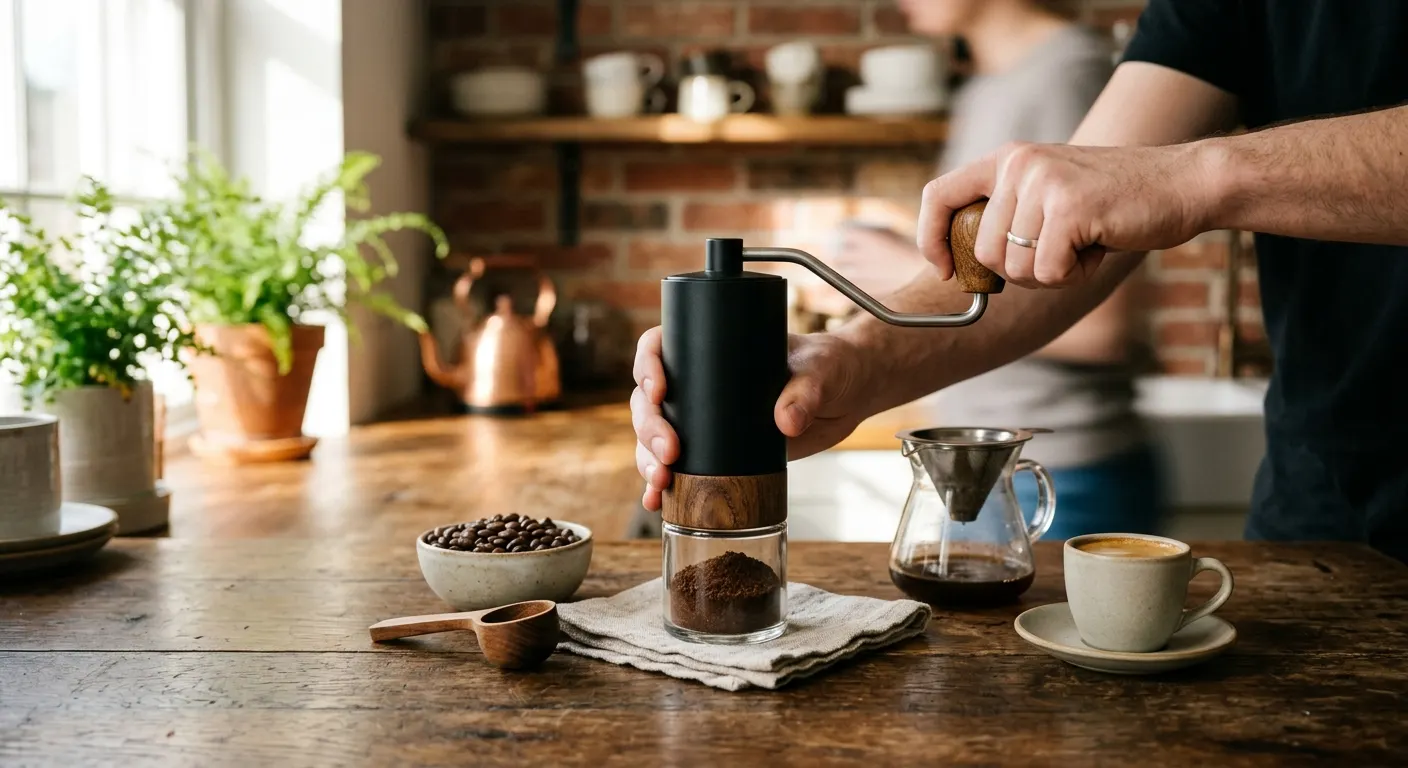
Best Hand Grinder for Espresso Under $200
By PullRatio . 9 min read . Updated June 2026
A hand grinder that can actually make espresso requires more than a narrow grind setting. It needs a burr set that produces a consistent particle size distribution at espresso-fine levels, a shaft with minimal wobble that does not let the burrs drift apart under load, and enough adjustment precision to make small moves when dialing in. Most hand grinders marketed for espresso do not meet those requirements. This guide covers the ones that do, explains why burr size and shaft stability matter, and is honest about the workflow cost of grinding a double shot by hand every morning.
Quick answer
A capable espresso hand grinder needs a consistent burr set, a stable dual-bearing shaft, and fine adjustment. The Timemore C3 Pro is the catalog pick: its S2C burrs pull real 9 bar espresso for one or two shots a day. The trade-off is 60 to 90 seconds of cranking per double, which becomes friction at higher volume.
This guide contains affiliate links. PullRatio may earn a commission at no cost to you.
What makes a hand grinder capable of espresso
Espresso requires a grind that is consistently fine and produces relatively uniform particle sizes. Fines, the very small particles that overextract quickly, should be limited. The mid-range particles should dominate. A grinder that produces a bimodal distribution with too many fines and too many coarse particles at the same time creates shots that are simultaneously under and overextracted, which is where sour-and-bitter-together problems originate.
Burr quality is the primary determinant of this. Larger burr diameter generally produces better particle consistency because the cutting geometry operates at higher speed relative to the coffee flow rate. The S2C burr design used in the Timemore C3 Pro Hand Grinder represents a specific approach to improving this at smaller burr sizes by adding a secondary cutting geometry to the inner burr face.
Shaft stability matters almost as much as burr quality. A hand grinder that lets the inner burr wobble during grinding effectively grinds at a variable gap, producing a wider particle distribution than the setting suggests. Dual-bearing shafts address this by using two bearing points to prevent lateral movement.
Adjustment precision is the third factor. Espresso operates in a narrow window where the difference between the correct grind and channeling can be a single click on a stepped grinder. Hand grinders with very coarse click increments, 40 or more microns per click, are challenging to dial in precisely for espresso.
Timemore C3 Pro: the catalog option and what it does well
The Timemore C3 Pro Hand Grinder is the hand grinder in the PullRatio catalog and the one we can speak to most directly. The S2C stainless steel burr set in the C3 Pro produces espresso-quality grinds with genuine consistency. The dual-bearing shaft stabilization limits burr wobble under the manual torque load of espresso-fine grinding.
The C3 Pro has stepped adjustment with settings that cover the espresso range. The steps are fine enough to make meaningful moves between shots when dialing in, though they are coarser than the micro-click systems in higher-end hand grinders like the 1Zpresso J-Max. For most medium and dark roasts, the C3 Pro settings are granular enough to find a good window.
The honest workflow note: grinding a 18 g double shot by hand takes 60 to 90 seconds of cranking at espresso-fine settings with the C3 Pro. That is manageable for one to two shots per day and works well for travel. For a household that pulls four or five shots on a weekend morning, 6 to 8 minutes of total grinding time before the first cup becomes a real friction point.
The C3 Pro is the right first hand grinder for espresso in a budget-constrained setup, for travel baristas, or as a backup to an electric grinder. Pair it with the Breville Bambino Plus for a compact travel or apartment setup, or use it as the entry point before committing to an electric grinder budget.
What to look for above the C3 Pro
The hand grinder category above $100 and up to $200 includes options with larger burrs and finer adjustment systems than the C3 Pro. The 1Zpresso J-Max sits at or just below $200 and uses 48 mm stainless steel conical burrs with an adjustment system that moves 8.8 microns per click, which is fine enough to make precise espresso adjustments. Reviews from the home espresso community consistently rate it as capable of electric-grinder-quality espresso when technique is consistent.
The Kingrinder K6 is a mid-range option that offers competitive burr quality at a lower price than the 1Zpresso J-series. The home espresso community has noted strong value-to-performance at around $80 to $100, with burr geometry designed specifically for espresso capability.
Note that neither the 1Zpresso J-Max nor the Kingrinder K6 are currently in the PullRatio catalog. The Timemore C3 Pro Hand Grinder is the catalog product we recommend. If budget allows for a hand grinder above $100, the 1Zpresso J-Max is the option the home espresso community most commonly recommends as the ceiling of what hand grinding can do for espresso before the workflow cost outweighs the quality.
Flat burrs versus conical burrs in hand grinders
Hand grinders use conical burrs almost universally. Flat burr hand grinders exist but are rare because flat burr geometry at hand-grinder size requires higher rotational speed to cut cleanly, and the manual torque available is limited. At the forces generated by hand grinding, flat burrs in a small diameter format can actually produce worse results than equivalent-quality conical burrs.
Conical burrs in hand grinders produce a particle distribution that, with quality burr sets and stable shafts, is entirely suitable for espresso. The Timemore C3 Pro Hand Grinder S2C conical burrs produce the consistent distribution needed for 9 bar extraction. The distinction between flat and conical burrs matters much more in electric grinders where motor speed is not a constraint.
When evaluating hand grinders for espresso, focus on burr diameter, shaft stability, and adjustment precision rather than burr geometry. A well-engineered conical burr hand grinder outperforms a poorly-engineered flat burr hand grinder at every price point.
Pairing a hand grinder with your espresso machine
The Timemore C3 Pro Hand Grinder pairs naturally with the Breville Bambino Plus as a compact, low-cost entry into real espresso. The 3-second heat-up on the Bambino Plus means the machine is ready before the grinding is done, which eliminates one source of morning friction in the hand-grinding workflow.
Use a Normcore Dosing Funnel in 54 mm clipped to the portafilter while grinding. Grinding directly into the portafilter with a funnel collar prevents coffee from spilling over the basket edge during the grind and the subsequent WDT stir. With a hand grinder, the grounds exit more slowly than with an electric grinder, so the funnel is especially useful for keeping the workflow contained.
After grinding, use a Normcore WDT Tool or IKAPE WDT Tool to break up clumps before tamping. Tamp with a Normcore Calibrated Tamper V4 in 53.3 mm. Pull the shot while tracking yield on a Timemore Black Mirror Nano Scale . This full workflow with a hand grinder and the Bambino Plus produces espresso that reflects the actual quality ceiling of the equipment rather than masking it through pressurized baskets or guessed doses.
When to upgrade from a hand grinder to electric
A hand grinder becomes the daily friction point in two situations: when you regularly pull more than two shots before the first cup, and when you want to dial in precisely for light roasts where small grind adjustments matter and you want to taste the difference shot over shot without 90 seconds of cranking between each pull.
When either of those situations applies, the Baratza Encore ESP at $170 to $195 is the natural electric upgrade from the Timemore C3 Pro Hand Grinder . It produces espresso-range grinds with the same intent as the C3 Pro but electrically, with the same Bambino Plus compatibility and Baratza service backing.
If you want flat-burr performance and stepless adjustment, the DF64 Gen 2 Single Dose Grinder is the step up from the Encore ESP. The jump from a hand grinder to the DF64 is a large quality improvement that you will taste immediately in cleaner, more balanced shots.
Featured in this guide
Keep reading
Related comparisons
Related roundups
FAQ
Frequently asked questions
Can a hand grinder really produce espresso-quality grinds?+
Yes, with the right burr set and shaft stability. A quality hand grinder like the Timemore C3 Pro with an S2C burr set and dual-bearing shaft produces consistent particle distributions capable of genuine 9 bar espresso extraction. The trade-off is workflow time: grinding a double shot takes 60 to 90 seconds by hand. The grind quality is real; the question is whether the time cost fits your daily routine.
What is the difference between flat and conical burrs in hand grinders?+
Hand grinders use conical burrs almost exclusively. Flat burr geometry at hand-grinder scale requires higher rotational speed than manual cranking provides to cut cleanly. Quality conical burrs in a hand grinder, like the S2C set in the Timemore C3 Pro, produce particle distributions suitable for espresso extraction. The flat versus conical distinction matters far more in electric grinders where motor speed is not a constraint.
How do I know when I need to upgrade from a hand grinder to an electric one?+
The hand grinder becomes a bottleneck when you regularly pull more than two shots before the first cup, when you want to dial in light roasts with rapid shot-over-shot adjustments, or when the 60 to 90 second grinding time is reducing how often you actually make espresso. Any of these are reasonable triggers to step up to an electric grinder like the Baratza Encore ESP or DF64 Gen 2.