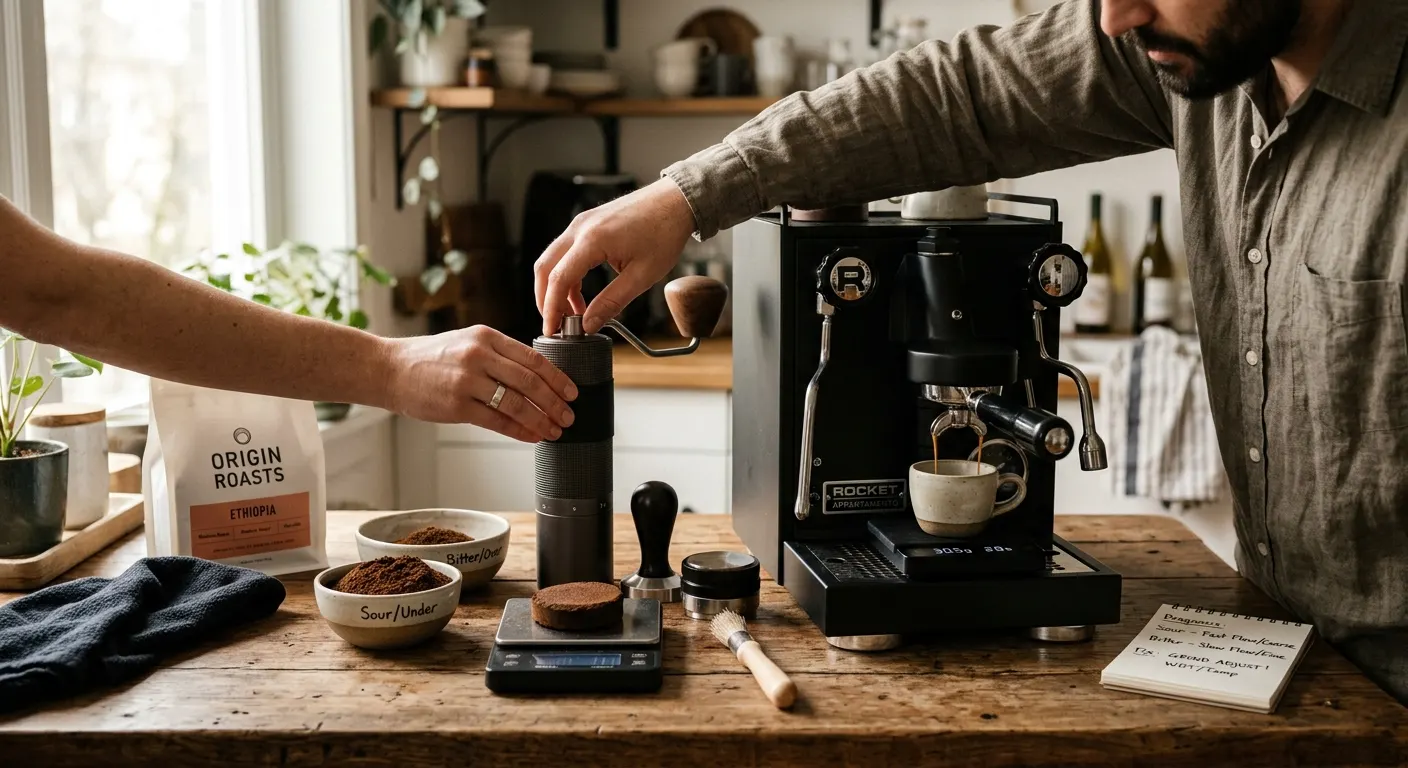
Why Is My Espresso Sour or Bitter? Fix Under and Over Extraction
By PullRatio . 10 min read . Updated June 2026
Sour espresso and bitter espresso are not the same problem, and the fixes point in opposite directions. Sour means underextraction: water moved through the puck too fast and pulled mostly the bright, acidic compounds while leaving the balanced sweetness and body behind. Bitter means overextraction: water was in contact with the grounds too long and pulled the harsh, astringent compounds that come out last. Sour and bitter at the same time usually means channeling: some parts of the puck were overextracted and others were barely touched. Each problem has a specific cause and a specific fix. This guide walks through all three and the tools that make the diagnosis reliable.
Quick answer
Sour means underextraction, so grind finer to slow the shot. Bitter means overextraction, so grind coarser to speed it up. Sour and bitter together points to channeling, fixed with WDT and a level tamp rather than a grind change. Change one variable at a time and confirm dose, yield, and time on a scale.
This guide contains affiliate links. PullRatio may earn a commission at no cost to you.
Sour espresso: underextraction and what causes it
Espresso extraction follows a sequence. The brightest, most soluble compounds extract first. Sweetness and body come from the middle of the extraction. Bitter, harsh compounds come last. Underextraction means the water moved through the puck so fast that it only pulled the first phase: bright acids, thin body, low sweetness.
The most common cause is grind too coarse. A coarser grind creates less flow resistance, so water passes through in under 20 seconds at a normal 9 bar pump pressure, pulling mostly the bright first-phase compounds. Grind finer to increase resistance and extend the contact time toward the 25 to 30 second range.
Other causes of underextraction include dose too low (less coffee creates less resistance), temperature too low (water below roughly 90 to 93 degrees Celsius extracts less efficiently), or channeling (where water bypasses most of the puck through a low-resistance path, leaving the majority of the grounds underextracted).
Use a Timemore Black Mirror Nano Scale or Acaia Lunar Scale to confirm the yield time. A shot that yields 36 g in under 20 seconds from a well-distributed puck is running too fast and needs a finer grind. On the Baratza Encore ESP , move two to three steps finer. On the DF64 Gen 2 Single Dose Grinder or Niche Zero , rotate the stepless ring a small amount toward finer and pull again.
Bitter espresso: overextraction and how to fix it
Overextraction pulls the harsh, drying compounds that make espresso taste flat, bitter, or astringent at the back of the mouth. A shot that pulls in 40 seconds or more at a normal dose is often overextracted. So is a shot that runs a correct time but with too high a dose for the basket, which creates the same effect through a different mechanism.
The most direct fix is to grind coarser. This increases flow rate and shortens contact time, moving extraction away from the harsh last-phase compounds. Move one or two steps coarser, pull a new shot, and track the time. If the shot now runs in 25 to 30 seconds rather than 40 or more, and the taste has more balance and less harshness, the adjustment worked.
Check dose weight as well. If you are using 21 g in a basket rated for 18 g, the overfilled puck creates excessive resistance that can produce the same overextraction symptoms as too-fine a grind. Use a Timemore Black Mirror Nano Scale to weigh doses accurately. A 0.1 g scale matters here because 2 g is a meaningful change to extraction in an 18 g dose.
Temperature can cause overextraction too. Most home machines run at a fixed boiler temperature; on a machine like the Gaggia Classic Pro with a PID, lowering the target temperature by a few degrees reduces extraction intensity for very light or sensitive roasts. On an unmodified machine, the cooling flush technique before pulling reduces group head temperature if overextraction persists with other variables corrected.
Sour and bitter together: channeling is the cause
When a shot tastes sour in the front and harsh or bitter in the finish, or hollow with both bright and unpleasant notes, the cause is usually channeling rather than a single direction extraction problem. Channeling means water carved a low-resistance path through the puck, overextracting the grounds along that path while underextracting most of the bed. The result is a cup that contains both extremes simultaneously.
Channeling is caused by an uneven puck. Dense clumps from grinding, an off-level tamp, an off-center dose, or a loose edge where the basket meets the grounds all create paths of lower resistance that water finds and exploits.
The fix is WDT technique. A Normcore WDT Tool breaks up the clumps formed during grinding so the whole bed has uniform density before tamping. Stir the bed in a slow circular motion, edge to center and back, until the surface is smooth with no visible clumps. Then tamp level with a Normcore Calibrated Tamper V4 in the correct portafilter size: 53.3 mm for the Bambino Plus and Barista Express, 58.35 mm for the Gaggia Classic Pro and Rancilio Silvia.
Use a Normcore Dosing Funnel clipped to the portafilter rim to contain grounds during the WDT stir. The funnel prevents grounds from spilling over the basket edge during the distribution step.
After correcting distribution and tamping, add a Normcore Puck Screen 58.5 mm on top of the puck before locking in. The screen spreads water from the shower screen more evenly across the puck surface, which reduces channeling risk from an unevenly wetting group head.
Diagnosing with a bottomless portafilter
The fastest diagnostic for channeling is visual: use a Bottomless Portafilter for Gaggia Classic Pro (58 mm) if you own a 58 mm machine. A bottomless portafilter removes the spouts and lets you watch the puck base during extraction.
Correct extraction looks like a single, even bloom of espresso building slowly and uniformly across the whole basket base, darkening at the edges at the same rate as the center. Channeling looks like streaks emerging from specific spots, sprays from edge gaps, or an uneven bloom where one side runs clearly faster than another.
If you see streaks from the basket edge, the dose is not level in the basket before tamping. If you see a spray from a center gap, a clump was not broken during WDT. If you see an off-center bloom, the tamp was not level. Each pattern points to a specific fix in your puck prep technique.
On a 54 mm machine like the Bambino Plus or Barista Express, 54 mm bottomless portafilters are available from third-party suppliers on Amazon. They serve the same diagnostic function as the 58 mm version.
The right equipment to make dial-in reliable
Diagnosing sour or bitter shots reliably requires a scale. Without weight data, you cannot tell whether a shot ran fast because of a coarse grind, a low dose, or channeling. Consistent numbers on a scale are what separate a methodical adjustment from a guess.
Use the Timemore Black Mirror Nano Scale as a minimum. Place it on the drip tray before locking in the portafilter, tare to zero, and watch the yield build in real time. Stop the shot at your target yield. A 1:2 ratio, 18 g in and 36 g out, is the standard starting point; adjust from there based on taste.
For tracking multiple shots across a dial-in session, the Acaia Lunar Scale Bluetooth app logs every pull with dose, yield, time, and flow rate. This turns the adjustment process into a readable record rather than a memory exercise.
The Niche Zero and DF64 Gen 2 Single Dose Grinder make grind adjustments precise enough to isolate changes. A grinder with only a few coarse espresso steps limits how small an adjustment you can make, which makes it harder to find the exact window between sour and bitter. Stepless or fine-stepped grinders let you move in micro-increments and find that window efficiently.
Featured in this guide
Keep reading
Related comparisons
Related roundups
FAQ
Frequently asked questions
My shot tastes sour. Should I grind finer or coarser?+
Grind finer. Sour usually means underextraction: the water moved through the puck too quickly and only pulled the bright acidic compounds. A finer grind creates more flow resistance, slows the shot down, and extends extraction time toward the 25 to 30 second window where the balanced compounds extract fully. Move one or two steps finer at a time and taste after each adjustment.
My shot tastes sour and bitter at the same time. What is happening?+
Sour and bitter together usually means channeling rather than a single direction extraction problem. Channeling happens when water finds a low-resistance path through the puck and overextracts those grounds while bypassing most of the bed. The fix is WDT: use a needle tool to break up coffee clumps before tamping so the whole bed has even density and water cannot find a shortcut.
How do I know if my grind change actually fixed the problem?+
Track dose, yield, and time on a scale across three consecutive pulls at the new grind setting. Give the grinder two shots to clear the previous setting from the retention path before judging. If the numbers are consistent across the three pulls and the taste improved, the change held. If results vary shot to shot at the same grind setting, the problem is puck prep consistency rather than grind direction.