Best Accessories for the Breville Barista Express
By PullRatio . 11 min read . Updated September 2026
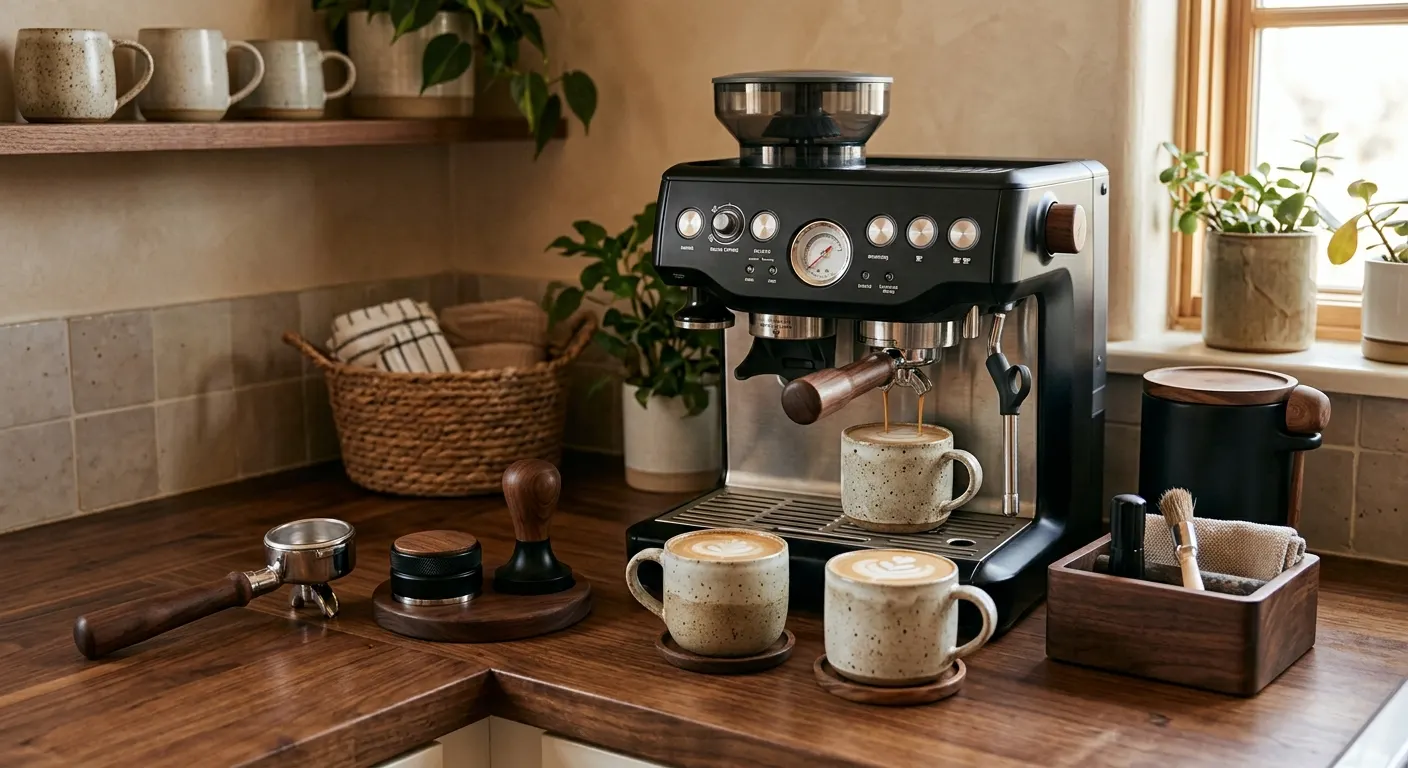
The Breville Barista Express ships as a complete system. Built-in grinder, portafilter, tamper, and milk jug all in one box at $600 to $700. For most beginners that all-in-one package is the point, but the included accessories have real limits. The stock pressurized basket masks grind quality. The included tamper requires guessing at pressure. There is no scale, no WDT tool, and no knock box. The machine itself is capable hardware: a 54 mm thermojet, a 9 bar pump, a functional steam wand. The accessories below are the additions that let it perform to that capability. Every one of them works with the 54 mm portafilter; where a 58 mm-only item exists, we say so.
Quick answer
The Barista Express hardware is sound, but its stock accessories cap results. The upgrades that matter most are a single-wall precision basket over the pressurized one, a WDT tool, a 53.3 mm calibrated tamper, a 0.1 g scale, and a knock box. All fit the 54 mm portafilter, so confirm 54 mm rather than the 58 mm standard when ordering.
This guide contains affiliate links. PullRatio may earn a commission at no cost to you.
The built-in grinder: what it can and cannot do
The Barista Express uses a 40 mm conical burr grinder with a stepped adjustment ring. It is capable of espresso-fine grinds and has enough settings to dial in most medium to dark roasts. It is not a reference grinder: the burrs are smaller than the 64 mm flat burrs in the DF64 Gen 2 Single Dose Grinder , and the stepped adjustment limits how precisely you can chase a moving target as beans age.
This is worth understanding before spending on accessories. The machine rewards accessory investment because the hardware is sound; the grinder is the one component you cannot easily replace. That said, good puck prep, a scale, and a precision basket will get noticeably more from the built-in grinder than running it stock with the pressurized basket.
If you are at a point where grind quality feels like the limiting factor, the Niche Zero is the grinder Barista Express owners step up to most often. For many baristas, that purchase happens 12 to 18 months into daily use. Until then, the accessories below extract real improvement from the built-in grinder.
Precision basket: the upgrade to make before anything else
The Barista Express ships with a pressurized basket in addition to the included single-wall basket. Use the single-wall basket from day one, not the pressurized one. The pressurized basket adds an artificial restriction that compensates for coarse or uneven grinds by forcing flow through a small hole regardless of how the puck is prepared. It makes extraction less sensitive to technique but also caps quality in a way that does not reflect what the machine can do.
For 54 mm single-wall baskets, the options are more limited than the 58 mm category, but aftermarket options with tighter hole tolerances than the stock Breville basket are available. The IMS Precision Basket 58 mm is a 58 mm item and does not fit the Barista Express; confirm 54 mm when shopping. The Breville-made single-wall basket included with the machine is a functional starting point; third-party 54 mm precision baskets on Amazon are available and offer tighter tolerances if you want to go further.
Once you are on a single-wall basket, the relationship between your grind and your shot quality becomes direct and honest. Every adjustment to the built-in grinder actually shows through the extraction rather than being absorbed by a pressurized secondary restriction.
WDT tool and dosing funnel: fix channeling before it starts
The Barista Express grinds directly into the portafilter, which is convenient but introduces clumping. Freshly ground coffee falls in with static charge and moisture that causes fine particles to stick together into dense clumps. When 9 bar of water pressure hits a clumpy, uneven puck, it finds the low-resistance gaps and channels through them, overextracting some grounds and skipping others. The shot tastes sharp, sour, and hollow.
A Normcore WDT Tool breaks those clumps before tamping. Insert the 0.35 mm needles into the coffee bed at a slight angle and stir in a slow circular motion from the outer edge inward, covering the whole bed in two to three rotations until the surface is smooth and uniform. This takes about 20 seconds and is one of the highest-impact cheap improvements for any home espresso machine.
The IKAPE WDT Tool is the budget entry point at $15 to $25 if you want to confirm the technique works for your setup before committing to the Normcore. Both tools work with the 54 mm portafilter.
Clip a Normcore Dosing Funnel in 54 mm to the portafilter rim before grinding. The funnel contains the grounds during the WDT stir, which matters when you are stirring at the basket edge. A 54 mm dosing funnel is a small purchase that makes the workflow noticeably cleaner.
Calibrated tamper: consistent pressure, consistent shots
The included Barista Express tamper is a plastic-handled basic tamper that gives you no feedback on pressure. Tamping with variable force is a variable you do not want when you are trying to isolate grind adjustments. A Normcore Calibrated Tamper V4 in 53.3 mm clicks at a set pressure every shot, removing that variable entirely.
Order the 53.3 mm version specifically. This is the correct size for the Barista Express 54 mm basket. The 58.35 mm version is for Gaggia Classic Pro and Rancilio Silvia owners. The click mechanism requires no special technique: press straight down until you hear and feel the click, then release. That is it.
The Espro Calibrated Tamper 58 mm is a 58 mm item that does not fit the Barista Express. Mention this only to flag the size trap: ordering the wrong tamper diameter is a common and easily avoided mistake.
Espresso scale: pull by weight, not time alone
The Barista Express has a built-in shot timer, and the machine is configured to stop at a set volume by default. Neither of these tells you the yield by weight. A shot that runs 30 seconds can yield anywhere from 25 to 45 grams depending on grind and dose. Pulling by weight is the only way to hold a consistent brew ratio.
The Timemore Black Mirror Nano Scale is the scale the home espresso community most often recommends for Barista Express owners. At $50 to $70, it gives you 0.1 g resolution and a low-enough profile to sit on the drip tray under the spout. Turn off the volumetric dosing setting, place the scale on the drip tray, tare to zero, start the shot, and stop at your target yield. A 1:2 ratio, 18 g dose to 36 g yield, is the standard starting point.
The Acaia Lunar Scale is the reference espresso scale with faster response and Bluetooth shot logging. If you track every pull and want to log the dial-in process, the Lunar makes that data available in a structured app. The Timemore covers the functional requirement at a fraction of the cost.
The Timemore Basic Plus Coffee Scale is a third option at $35 to $50 that works for dosing in but has a slower response time that makes live yield tracking less accurate. It is better than no scale, adequate for beginners who want to start measuring before committing to a dedicated espresso scale.
Knock box: the workflow item most people defer too long
The Barista Express does not come with a knock box. Knocking the spent puck out with the portafilter into a trash can or drawer is messy and damages portafilter handles over time. A knock box is one of those purchases that seems optional until you own one, after which it is impossible to imagine the workflow without it.
The Rhinoware Hard Knock Box is the compact daily-driver choice: a rubberized knock bar, a weighted non-slip base, and a removable inner that rinses out in seconds. It fills up after 4 to 6 shots, which is fine for most home sessions. The Crema Pro Knock Box with Removable Knock Bar holds 10 to 12 shots before needing to be emptied, making it the better choice for households that pull multiple shots per session without stopping.
Cleaning: backflushing and descaling the Barista Express
The Barista Express has a three-way solenoid valve and accepts backflushing. Run Urnex Cafiza Espresso Machine Cleaning Tablets weekly: place one tablet on the machine's supplied cleaning disc, seated in the filter basket, lock in the portafilter, and run the backflush cycle per the Breville documentation. Then run five to ten plain water backflush cycles to clear the cleaning solution.
Descale every 2 to 3 months using Puly Caff Espresso Machine Descaler . The machine will prompt you with a light indicator when it calculates a descale is due, but in hard-water areas it is worth descaling on a calendar schedule regardless of the indicator. Brush the shower screen and group head with a Espresso Group Head Cleaning Brush after every session.
The built-in grinder on the Barista Express requires its own cleaning. Use the grinder cleaning mode documented in the manual, running grinder cleaning tablets or rice-grain-sized cleaning pellets through the burrs monthly to remove coffee oil from the burr chamber. This is separate from the machine cleaning and often overlooked.
Featured in this guide
Keep reading
Related comparisons
Related roundups
FAQ
Frequently asked questions
Do I need a separate grinder if I already have the Barista Express?+
Not immediately. The built-in 40 mm conical burr grinder is capable of espresso-fine grinds and can be dialed in with a scale and good puck prep. Most owners find the built-in grinder adequate for 12 to 18 months of daily use before wanting more precision. When grind quality starts feeling like the ceiling, the Niche Zero is the grinder Barista Express owners most often step up to.
What size tamper and dosing funnel fit the Breville Barista Express?+
The Barista Express uses a 54 mm portafilter, so you need a 53.3 mm tamper and a 54 mm dosing funnel. This is different from the 58 mm commercial standard used by the Gaggia Classic Pro and Rancilio Silvia. Confirm the size before ordering calibrated tampers and dosing funnels, since the wrong size is a common and easily avoided purchase mistake.
Why should I turn off the volumetric dosing on the Barista Express if I am using a scale?+
The volumetric setting stops the shot at a programmed volume, which varies with grind and pressure. Using a scale gives you weight-based precision that volumetric dosing does not. When you weigh the yield, you can hold a consistent brew ratio regardless of what the volumetric setting would have done. Put the scale on the drip tray, tare it, and stop the shot manually at your target weight.