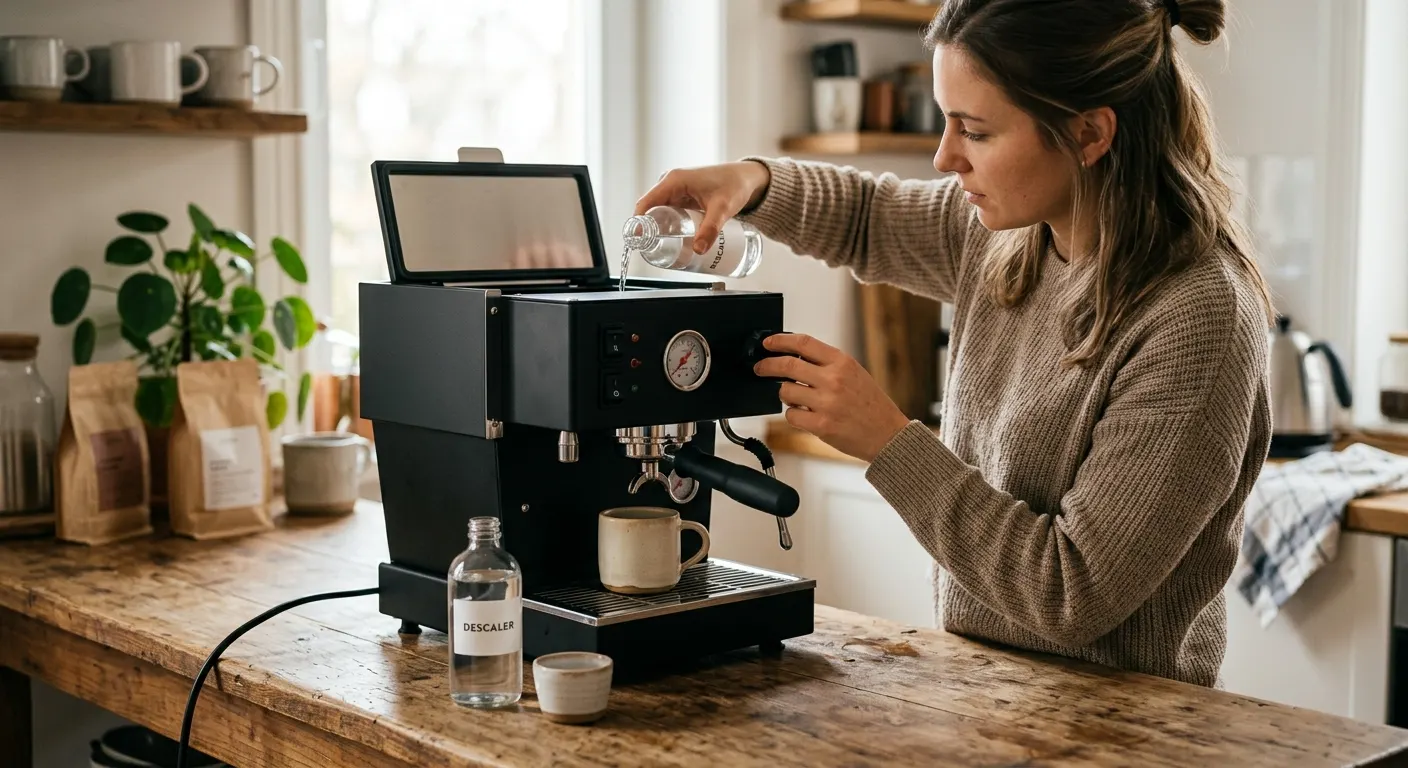
How Often Should You Descale an Espresso Machine?
By PullRatio . Updated June 2026
Descaling is the maintenance task that decides whether your espresso machine lasts five years or fifteen. Limescale is mineral buildup from the calcium and magnesium in your water, and every heating cycle leaves a little more of it inside the boiler and water paths until flow drops and temperature stability suffers. The frequency that keeps a machine healthy depends almost entirely on your water. This guide gives you a clear schedule by water hardness, separates descaling from backflushing, and shows how to slow scale down so you descale far less often.
Quick answer
On hard water, descale every two to three months. On soft water, every three to four months. With very hard water and heavy daily use, monthly may be needed. Descaling removes mineral scale from the boiler and water paths and is a different job from backflushing, which clears coffee oils. Filtering your water lets you descale less often.
This guide contains affiliate links. PullRatio may earn a commission at no cost to you.
How often to descale, by water hardness
Water hardness is the variable that sets your schedule. On hard water, the established guidance is to descale every two to three months, because the higher mineral content builds scale faster. On soft water, every three to four months is enough. In areas with very hard water and heavy daily use, monthly descaling can be necessary to stay ahead of the buildup. If you do not know your hardness, an inexpensive test strip or your local water report tells you where you sit.
Usage scales the frequency alongside hardness. A machine pulling ten shots a day heats and cools far more than one making a single morning espresso, and every cycle deposits more minerals. Take your water hardness, your daily volume, and your manufacturer's recommendation together rather than relying on a single number. When in doubt, descale on the more frequent end; scale is far easier to prevent than to remove once it has hardened.
Descaling and backflushing are two different jobs
These two maintenance tasks get confused constantly, and doing one does not cover the other. Descaling removes mineral scale from the inside of the boiler, the thermoblock, and the internal water paths. Backflushing removes coffee oils and grounds from the group head, shower screen, and three-way solenoid valve. One deals with your water, the other with your coffee, and a healthy machine needs both on their own schedules.
Backflushing is the more frequent of the two. With a Cafiza Blind Filter Basket (Backflush Disc) seated in the portafilter and a dose of Urnex Cafiza Espresso Machine Cleaning Tablets , you run a short cycle that pushes cleaning solution back through the group and solenoid to dissolve the oils that build up there. Weekly is a reasonable cadence for a daily-use machine. Finish with a Espresso Group Head Cleaning Brush on the shower screen and gasket to clear the fresh grounds a backflush cannot reach. Keep this on its own weekly rhythm and descale on the monthly-to-quarterly schedule above.
Use a real descaler, not vinegar
The descaler matters because it sits in contact with the boiler, seals, and metals inside your machine. The Puly Caff Espresso Machine Descaler is a food-safe liquid descaler formulated to remove calcium and lime scale from the boiler, thermoblock, and water paths without attacking the seals or metals, which is why Italian espresso technicians use it. It is the kind of correctly formulated product worth choosing over a generic supermarket option.
Vinegar comes up constantly as a cheap alternative, and it is a false economy. It is weaker at dissolving scale, leaves a smell and taste that takes many flushes to clear, and is harsher on some seals over time. A purpose-made descaler costs a few dollars per use and is formulated for exactly this job. Follow your machine's descaling routine, run the solution through, and rinse thoroughly with fresh water until no descaler taste remains.
Stop scale at the source
The most effective way to descale less often is to put less scale in the machine to begin with. The BWT Magnesium Mineralizer Water Filter Jug reduces the calcium that forms limescale while adding magnesium, a mineral the specialty coffee community has identified as improving extraction. Filling your reservoir from a scale-reducing jug attacks the problem at the source, so the boiler accumulates mineral far more slowly.
This is a two-for-one upgrade: it protects the machine and improves the water you actually brew with. In a hard-water region it can stretch your descaling interval noticeably and reduce the risk of a scale-clogged valve down the line. It does not eliminate descaling, because no filter removes every mineral, but it shifts you from the frequent end of the schedule toward the relaxed end.
Signs you have waited too long
A machine that is overdue for descaling tells you. Flow slows as scale narrows the water paths, the machine takes longer to come to temperature, and shots can taste flat or inconsistent as temperature stability suffers. In bad cases a scaled-up solenoid or valve sticks, which is a repair rather than a cleaning. Catching it before that point is the whole reason to keep a schedule.
If you have inherited a machine or skipped descaling for a long time, expect the first descale to take more than one cycle to fully clear the buildup. After that, get on the hardness-based schedule above and stay on it. Consistent, scheduled descaling with a proper descaler, backed by filtered water, is what keeps a machine pulling the same shot in year five that it did on day one.
Featured in this guide
Keep reading
Related roundups
FAQ
Frequently asked questions
How often should I descale my espresso machine?+
It depends on your water. Descale every two to three months on hard water, every three to four months on soft water, and as often as monthly with very hard water and heavy daily use. Account for both your water hardness and how many shots you pull per day, and descale on the more frequent end when unsure.
Is descaling the same as backflushing?+
No. Descaling removes mineral scale from the boiler and internal water paths and is done every one to three months. Backflushing removes coffee oils from the group head and solenoid valve using a blind basket and cleaning tablets, and is done about weekly. A machine needs both, on their own separate schedules, to stay healthy.
Can I use vinegar to descale an espresso machine?+
It is not recommended. Vinegar dissolves scale less effectively than a purpose-made descaler, leaves a taste and smell that take many flushes to clear, and can be harsher on seals over time. A food-safe espresso descaler is formulated for contact with the boiler and seals and costs only a few dollars per use. Use the right product.