Best Espresso Scale for Dialing In
By PullRatio . 6 min read . Updated June 2026
Dialing in espresso means changing one variable, pulling a shot, and reading what happened. You cannot read what happened without measuring it, which is why a scale is the instrument that makes dial-in repeatable rather than a guessing game. The right espresso scale reads to 0.1 g, responds fast enough to catch the shot as it pours, and is slim enough to sit under the portafilter on the drip tray. This guide covers the scales that meet those requirements at three price points, from the Acaia Lunar the professional community uses down to capable budget options, and the specs that separate a dial-in scale from a kitchen scale.
Quick answer
The best espresso scale for serious dial-in is the Acaia Lunar: fast 0.1 g response that tracks a live pour, plus Bluetooth logging. Most people do not need to spend that much. The Timemore Black Mirror Nano gives the same 0.1 g resolution and a slim under-portafilter fit for roughly a third of the price.
This guide contains affiliate links. PullRatio may earn a commission at no cost to you.
Why a scale is non-negotiable for dialing in
Pulling shots by time alone hides the most important number: yield. The same 30-second shot can pour anywhere from 28 to 40 grams depending on grind and flow, and those are completely different drinks. Without weighing the yield, you cannot hold a consistent brew ratio, and you cannot isolate what changed when you adjust the grinder. Dial-in becomes guesswork.
A scale fixes that by letting you weigh the dose in and the espresso out, then target a ratio, typically 1:2 by weight, such as 18 g in to 36 g out, over 25 to 30 seconds. When the dose and yield are consistent shot to shot, the grind setting becomes the only variable you are actually changing, which is the entire point of dialing in.
The specs that matter: resolution, response, and fit
Three specs separate an espresso scale from a kitchen scale. Resolution must be 0.1 g, because espresso works in small doses where a single gram meaningfully changes the ratio and the taste. A scale that reads in whole grams is too coarse to dial in reliably.
Response time matters if you want to track the shot live and stop at your target yield rather than guessing. A fast scale updates quickly enough to catch the end of the pour; a slow one lags, which is fine for weighing the dose but less ideal for stopping a shot precisely. Fit is the third: the scale has to sit under the portafilter spout on the drip tray without hitting the tray wall, so a low profile matters on machines with tight clearance.
Best overall: Acaia Lunar ($210 to $230)
The Acaia Lunar Scale is the community standard for a reason. It pairs 0.1 g resolution with a sub-half-second response that genuinely tracks a live pour, so you can stop the shot at your target yield rather than reading it after the fact. Its low profile fits under most portafilters, and the integrated shot timer means weight and time live on one device.
The feature that sets it apart for dial-in specifically is Bluetooth logging. The companion app records every shot, which turns a series of pull-and-adjust cycles into a readable history of what you changed and what improved. For a barista who tracks shots seriously, that record is what makes dial-in systematic rather than remembered. The honest caveats are the premium price and a proprietary charger that is easy to misplace.
Best value: Timemore Black Mirror Nano ($50 to $70)
The Timemore Black Mirror Nano Scale is the most-recommended first scale in home espresso because the accuracy-to-price ratio is genuinely strong. It delivers the same 0.1 g resolution as the Acaia at roughly a third of the price, with a low enough profile to fit under a standard portafilter and a built-in timer.
The trade-offs are honest and modest. Response time is slightly slower than the Lunar, noticeable mainly at the very end of the shot, and there is no Bluetooth logging, so you track shots manually or not at all. For the vast majority of home baristas dialing in by hand, neither limitation actually holds back the process. If you are buying your first espresso scale, this is the default answer.
There is an even cheaper entry, the Timemore Basic Plus Coffee Scale at $35 to $50, which also reads to 0.1 g and is USB rechargeable. Its slower response makes it better for weighing the dose than tracking live yield, so it suits dosing-in more than stopping a shot to the gram.
Best for tight clearance: Felicita Parallel ($80 to $110)
If your machine has a tall drip tray and other scales do not fit comfortably under the spout, the Felicita Parallel Scale solves the clearance problem. Its ultra-thin body is among the slimmest on the market, which buys the few millimeters that decide whether a scale fits under the portafilter on machines where the Timemore or Acaia is too tall.
It reads to 0.1 g with a responsive enough display for espresso and shows weight and time together on a clean readout. Response is adequate rather than Acaia-fast, and the Bluetooth version adds cost without the app depth of the Acaia ecosystem. Buy it specifically when fit is your binding constraint; otherwise the Timemore covers the same core function for less.
How to use the scale during dial-in
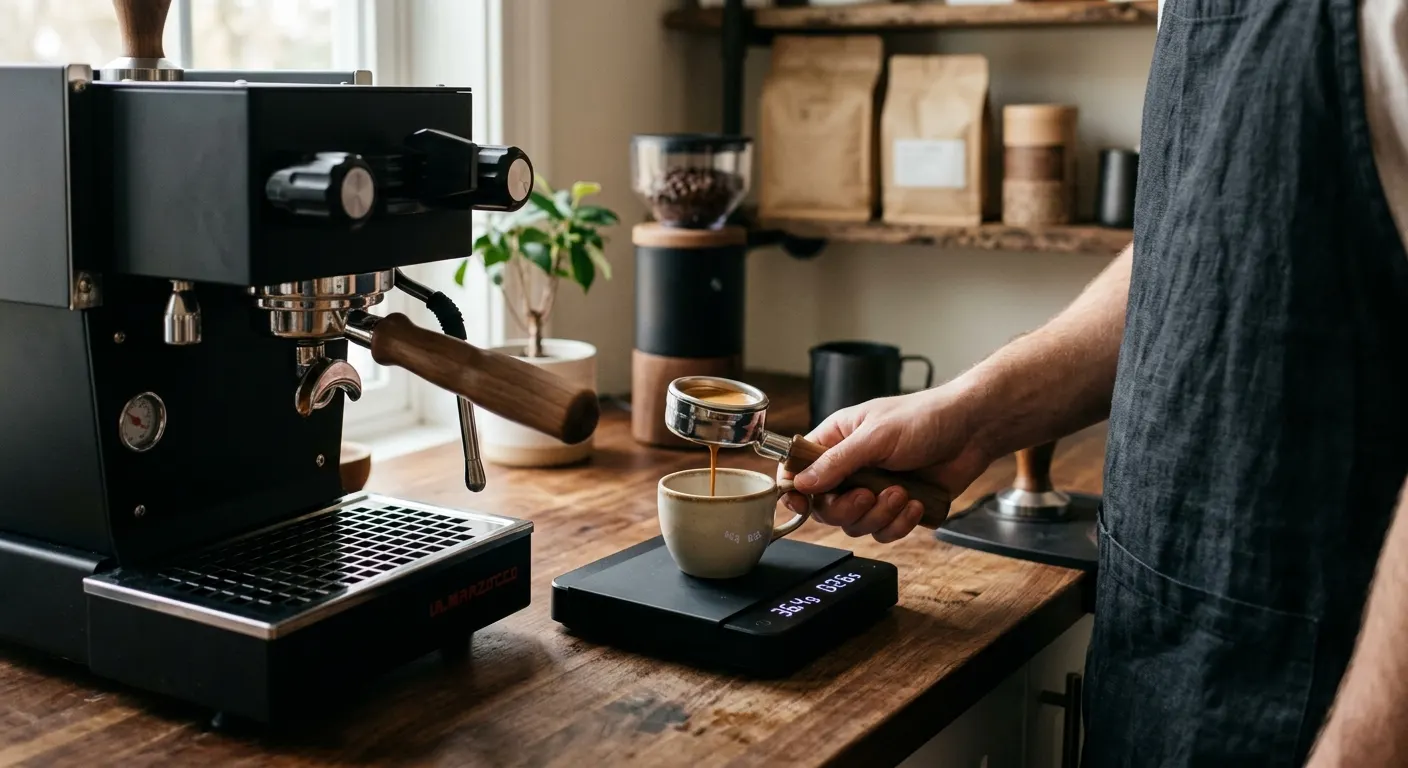
Place the scale on the drip tray, set an empty cup on it, and tare to zero before locking in the portafilter. Start the shot and the timer together, then watch the yield climb and stop at your target, 36 g for a standard 18 g dose at a 1:2 ratio. Note the time it took.
If the shot hits 36 g in under 20 seconds and tastes sour, grind finer to slow it down. If it stalls past 35 seconds and tastes bitter, grind coarser. Change the grind, not the dose, and give each new setting a full shot to clear the grinder's retention path. With the scale holding dose and yield steady, the grind is the only thing you are moving, which is exactly what makes the process repeatable.
Featured in this guide
Keep reading
Related comparisons
Related roundups
FAQ
Frequently asked questions
What is the best espresso scale for dialing in?+
The Acaia Lunar is the best if you track shots seriously, with fast 0.1 g response and Bluetooth logging that records every pull. Most people do not need to spend that much. The Timemore Black Mirror Nano matches the 0.1 g resolution and slim fit for about a third of the price and is the standard first espresso scale.
Why does an espresso scale need 0.1 gram resolution?+
Espresso works in small doses where a single gram meaningfully changes the brew ratio and the taste. A 0.1 gram resolution lets you weigh the dose precisely and watch the yield climb accurately in real time. Kitchen scales that read in whole grams are too coarse to dial in shots reliably, which is why a dedicated espresso scale matters.
Does the scale need to fit under the portafilter while pulling?+
Ideally yes. Pulling directly onto the scale lets you watch the yield live and stop at your target rather than guessing. That requires a low profile so the scale sits on the drip tray under the spout without hitting the tray wall. On machines with tall trays, a slim scale like the Felicita Parallel solves the fit problem.